In the current Perp DEX sector, the arms race between "liquidity" and "security" has entered its second half, and "ecosystem prosperity" is redefining the moat of on-chain exchanges.
On one side is Hyperliquid, which, relying on its highly advantageous Builder Code mechanism, has already nurtured a massive application network consisting of 80+ active developers. From the seamless integration of mainstream wallets to the exclusive terminals of hardcore quantitative institutions, this ecosystem has accumulated a staggering $64.22M in revenue. On the other side is the hardcore player Lighter, backed by top-tier capital (Founders Fund, a16z) and rigidly dedicated to Ethereum L2 institutional-grade security. In Lighter's current landscape, ecosystem application revenue remains at "zero," and all protocol-level revenue relies entirely on its unique dual-tier model of "free for retail + paid for institutions."
The stark contrast between $64.22M and $0 is not merely a gap in accounting scale, but a fierce collision between two evolutionary paths in on-chain finance. This article will break down the top ten Builder applications within the Hyperliquid ecosystem, using real on-chain data to reveal the operational logic of its ecosystem flywheel.
1. How Does the Builder Code Reshape the Revenue Landscape?
1.1 What is the Builder Code?
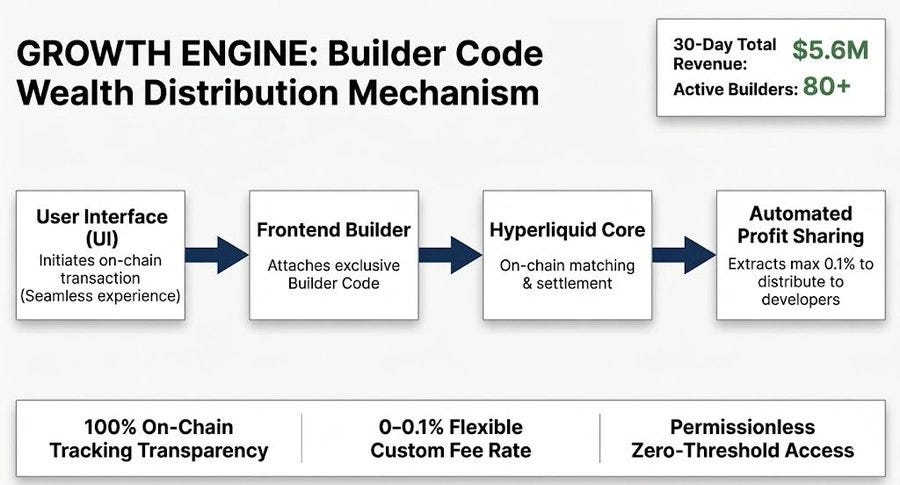
Hyperliquid's Builder Code mechanism allows third-party developers to attach a Builder Code when sending orders to Hyperliquid, thereby collecting an additional fee (up to 0.1%) from every executed trade. The core features of this mechanism are:
-
On-chain Transparency: All Builder revenues can be tracked on-chain.
-
Flexible Pricing: Each Builder can set their own fee rate (0-0.1%).
-
Seamless User Experience: Fees are deducted from the trading fees, resulting in no difference in user experience.
-
Permissionless: Any developer can register a Builder Code.
As of March 2026, the Hyperliquid Builder Code ecosystem has 80+ active Builders, with a historical cumulative revenue of $64.22M and a 30-day revenue of approximately $5.6M.
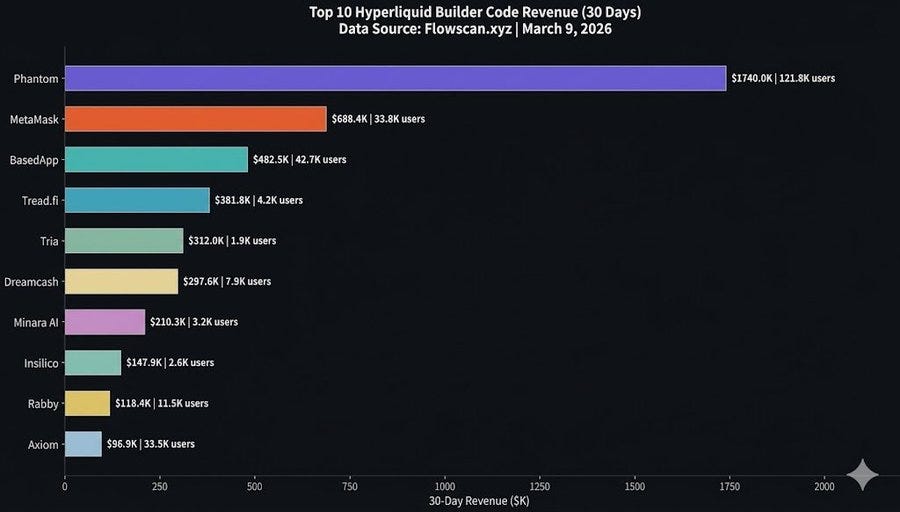
2. Breakdown of Hyperliquid's Top 10 Apps and Their Business Logic
2.1 "Traffic is King": The Overwhelming Advantage of Wallet Giants
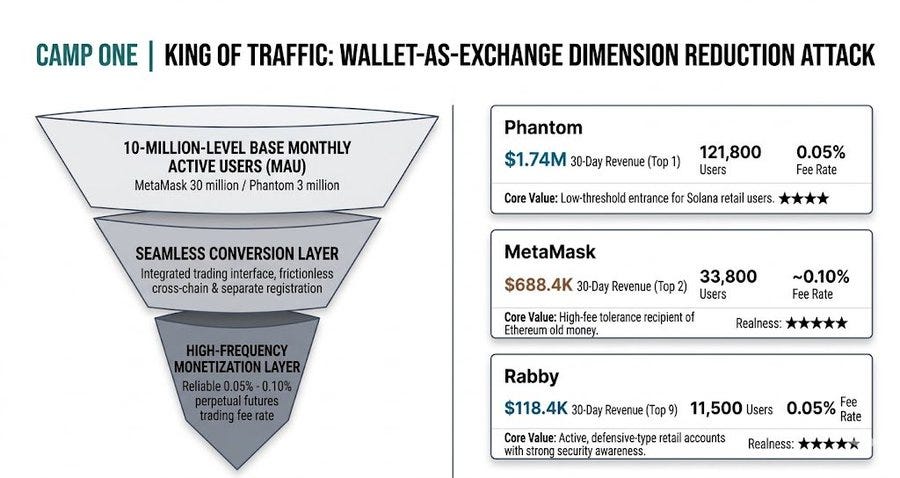
2.1.1 Phantom
Product Positioning: Phantom is the most mainstream wallet in the Solana ecosystem, with over 3 million monthly active users. Starting in the second half of 2025, Phantom directly integrated Hyperliquid perpetual contract trading features into the wallet interface, allowing users to trade perps without leaving the wallet. This was a crucial step in Phantom's transition from a "storage tool" to a "trading platform."
Revenue Mechanism: Phantom charges an additional 0.050% fee on every Hyperliquid perp trade via the Builder Code. Based on a 30-day trading volume of $3.48B, the $1.74M revenue matches perfectly ($3.48B × 0.050% = $1.74M). The data is highly consistent, and the revenue authenticity is extremely high.
User Persona: Phantom's Hyperliquid users are primarily retail users from the Solana ecosystem, with the following specific traits:
-
Already hold Solana assets and wish to engage in leveraged trading without leaving the wallet.
-
Have some understanding of DeFi but are unwilling to learn complex, standalone trading platforms.
-
Medium trading frequency, contributing an average revenue of $139 per person (30 days), classifying them as moderately active users.
-
The unique user count of 121,800 is the highest among all Builders, indicating a massive user base.
Core Value Proposition: "Your wallet is your exchange." The core pain point Phantom solves is: users already manage assets within Phantom, and switching to another platform (the official Hyperliquid website) requires extra steps. By embedding the trading portal within the wallet, Phantom dramatically lowers the barrier to entry. For Solana users, Phantom is their main gateway to interacting with the DeFi world; this traffic advantage cannot be replicated by other Builders.
Competitive Advantage: Phantom's core advantage lies in its user base (3 million MAU) and brand trust. While other Builders need to actively acquire customers, Phantom only needs to turn on a new feature for its existing users. Its 121,800 unique users are 3.6 times that of the second place (MetaMask's 33,800).
2.1.2 MetaMask
Product Positioning: MetaMask is the largest wallet in the Ethereum ecosystem, with over 30 million global monthly active users. In 2025, MetaMask integrated multi-chain DeFi operations through its MetaMask Portfolio feature, which included Hyperliquid perpetual contract trading. Similar to Phantom, MetaMask treats Hyperliquid as an important component of its multi-chain trading capabilities.
Revenue Mechanism: MetaMask collects trading fees via the Builder Code. Looking at the data, a trading volume of $688.4M generated $688.4K in revenue, corresponding to a fee rate of approximately 0.10% (near the maximum limit), though the official specific rate has not been publicly disclosed. This rate is significantly higher than Phantom's (0.050%), which may reflect that MetaMask users are less sensitive to fee rates.
User Persona: MetaMask's Hyperliquid users are mainly intermediate to advanced users in the Ethereum ecosystem:
-
Hold Ethereum assets and wish to explore Hyperliquid's high-performance trading experience.
-
Familiar with DeFi but accustomed to executing on-chain application operations via MetaMask.
-
Average revenue contribution per person is $136 (30 days), similar to Phantom users.
-
33,800 unique users, roughly 1/4 the size of Phantom's.
Core Value Proposition: "The lowest-barrier entry path for Ethereum users to access Hyperliquid." MetaMask users are generally unfamiliar with the Solana ecosystem, and the official Hyperliquid website requires separate registration. MetaMask provides a familiar interface for Ethereum users, lowering the psychological barrier to cross-chain exploration.
2.1.3 Rabby
Product Positioning: Rabby is a professional wallet for the Ethereum ecosystem developed by the DeBank team, renowned for its excellent security features:
-
Pre-transaction simulation: Preview transaction results before signing. Multi-chain asset management.
-
Built-in DeFi operation interface.
-
Recently integrated Hyperliquid perpetual contract trading.
Revenue Mechanism: Rabby charges a 0.05% Builder Code fee; a trading volume of $583.18M generated $118.4K in revenue. The average revenue contribution per person is $42.55, the lowest among all Top 10 Builders, indicating that the user base primarily consists of small-to-medium retail traders.
User Persona: Rabby's users are security-conscious users in the Ethereum ecosystem:
-
11,500 unique users, a medium-sized scale.
-
Have high security requirements; the core reason for choosing Rabby is its security features.
-
Low average revenue contribution ($42.55), showing users primarily engage in small-amount trading.
-
Relatively conservative in their use of Hyperliquid.
Core Value Proposition: "A security-first DeFi operation interface." Rabby's core differentiator is its pre-transaction simulation feature, allowing users to see the actual effects of a transaction before signing, thereby significantly reducing the risk of phishing and operational errors. For users with strong security awareness, Rabby is an irreplaceable choice.
2.2 "The All-in-One Butler": Super Apps and Account Abstraction Gateways
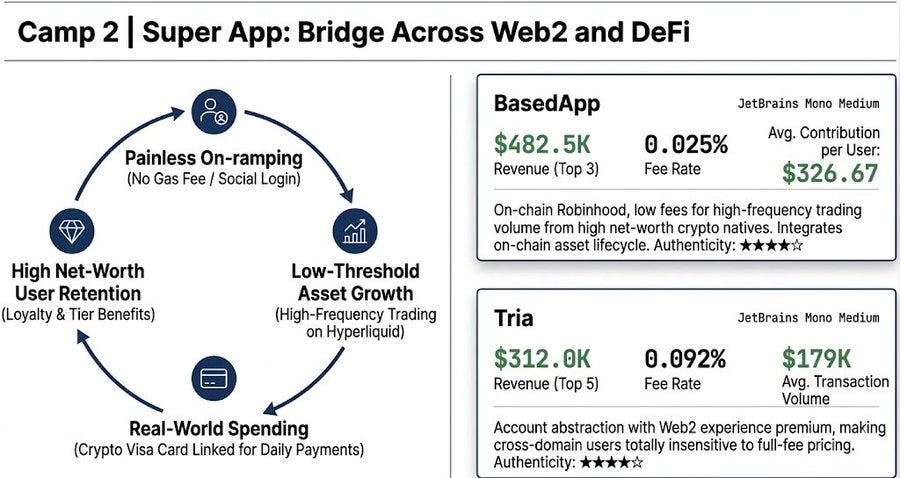
2.2.1 BasedApp
Product Positioning: BasedApp (Based) is a crypto super app, positioned as the "on-chain Robinhood." Its core features include:
-
Hyperliquid perpetual contract trading (primary revenue source).
-
Crypto Visa debit card (can directly spend on-chain assets).
-
Multi-chain asset management.
-
Social features (copy trading, trade sharing).
Revenue Mechanism: Based charges a 0.025% Builder Code fee. The rate is lower than Phantom (0.050%), but the trading volume is higher ($1.94B vs $3.48B). This strategy reflects Based's positioning: attracting high-frequency traders through low fee rates, exchanging price for volume.
User Persona: Based's user persona is the most unique:High-net-worth DeFi native users:
-
average revenue contribution is $326.67, 2.4 times that of Phantom.
-
42,700 unique users, but with a per capita trading volume far higher than Phantom.
-
Willing to pay a premium for a "Super App" experience.
-
Visa cardholders who directly use on-chain assets for daily consumption.
Core Value Proposition: "Full lifecycle management of on-chain assets." The pain point Based solves is: DeFi users' assets are trapped on-chain and cannot easily be used for real-world spending. Based's Visa card bridges on-chain assets with real-world consumption scenarios, a unique value that other Builders cannot provide.
2.2.2 Tria
Product Positioning: Tria is a multi-chain account abstraction wallet, positioned as the "lowest-barrier entry point for Web2 users entering Web3." Core features:
-
Seedless (uses MPC technology, login via email/social accounts).
-
Gasless (Tria covers Gas fees).
-
Unified multi-chain account (the same address works across all EVM chains).
-
Built-in Hyperliquid perpetual contract trading.
-
Up to 15% APY (via DeFi protocols).
-
Crypto Visa card.
Revenue Mechanism: Tria collects Hyperliquid trading fees via the Builder Code. A trading volume of $340.44M generated $312K in revenue, corresponding to a fee rate of approximately 0.092%, close to the maximum limit. This reflects that Tria users are insensitive to fee rates (because Tria's core selling point is the "gasless" experience, not low trading fees).
User Persona: Tria's users are the most typical Web2-to-Web3 transition users:
-
New users who have never used MetaMask or Phantom.
-
Log in via Google/Apple accounts, with no need to manage private keys.
-
Average revenue contribution of $182.52, a medium level.
-
Only 1,900 unique users, but a high per capita trading volume ($179,179).
Core Value Proposition: "Allowing Web2 users to enter DeFi seamlessly." Tria solves the biggest user experience pain points in Web3: complex seed phrase management, incomprehensible Gas fees, and tedious multi-chain operations. Through account abstraction technology, Tria completely hides these complexities; users only need to log in with an email to trade on Hyperliquid.
2.3 "The Hardcore Engine": Quantitative Terminals and High-Frequency Trading Speedsters
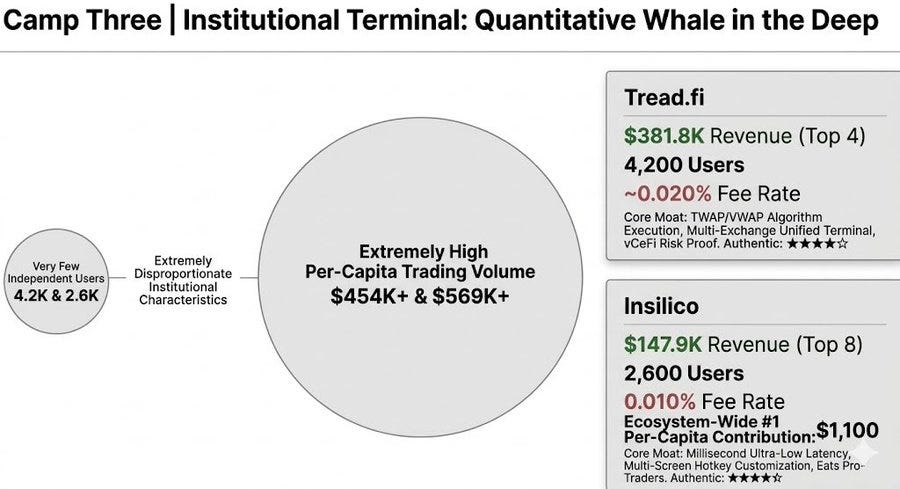
2.3.1 Tread.fi
Product Positioning: Tread.fi is an institutional-grade algorithmic trading terminal and OEMS (Order Execution Management System), founded by David Jeong, a former Morgan Stanley quantitative Vice President. It completed a $3.5 million Pre-Seed funding round in July 2024.
Core features:
-
Unified multi-exchange terminal: Simultaneously connects to CEXs and Perp DEXs like Binance, Bybit, OKX, and Hyperliquid.
-
Algorithmic execution suite: TWAP, VWAP, market-making bots, basis arbitrage.
-
vCeFi: Makes CEX trading data verifiable on-chain for DeFi lending and risk proofs.
-
Self-hosted TaaS: Institutions can deploy on a private cloud; API keys never leave the local environment.
Revenue Mechanism: Tread.fi collects Hyperliquid trading fees via the Builder Code. A trading volume of $1.91B generated $381.8K in revenue, corresponding to a fee rate of approximately 0.020%. Notably, Tread.fi has only 4,200 users, but a massive trading volume of $1.91B, translating to a per capita trading volume of roughly $454,762, which is a typical characteristic of institutional/quantitative users.
-
Quantitative market makers, arbitrage bots, hedge funds.
-
Massive daily trading volumes, but an extremely small user count (4,200).
-
Average revenue contribution of $321.93, second only to BasedApp.
-
Require professional algorithmic execution tools like TWAP/VWAP.
Core Value Proposition: "The professional tool layer for institutional traders on Hyperliquid." The pain point Tread.fi solves is: Hyperliquid's official interface lacks institutional-grade algorithmic execution features. Quantitative institutions need TWAP order slicing, multi-exchange hedging, vCeFi risk proofs, etc., all of which are Tread.fi's core values.
2.3.2 Insilico
Product Positioning: Insilico Terminal is a professional trading interface built for speed and ease of use, created by veteran traders and developers with decades of experience. Positioned as a "supercharged trading interface," it focuses on:
-
Ultra-low latency order execution.
-
Professional-grade charting and analysis tools.
-
Multi-account management.
-
Advanced order types (conditional orders, trailing stops, etc.).
Revenue Mechanism: Insilico charges an extremely low Builder Code fee of 0.010%, but its $1.48B trading volume generated $147.9K in revenue. The average revenue contribution is a staggering $1,100, one of the highest among all Builders, indicating its users are ultra-high-frequency traders.
User Persona: Insilico's users are professional quantitative traders and high-frequency traders:
-
Only 2,600 unique users, but an extremely high per capita trading volume of roughly $569,231.
-
Average revenue contribution of $1,100, indicating an extremely high trading frequency.
-
Extremely sensitive to latency and execution quality.
-
Require professional-grade tools and are willing to pay for them.
Core Value Proposition: "The fastest professional trading terminal on Hyperliquid." The pain point Insilico solves is: While Hyperliquid's official interface is already fast, professional traders need more custom features (hotkeys, multi-screen layouts, conditional orders, etc.). Insilico provides these professional tools while maintaining an extremely low additional fee rate (0.010%).
2.4 "The Boundary-Breaking Newcomers": AI Trading and Asset Cross-Border Bridges
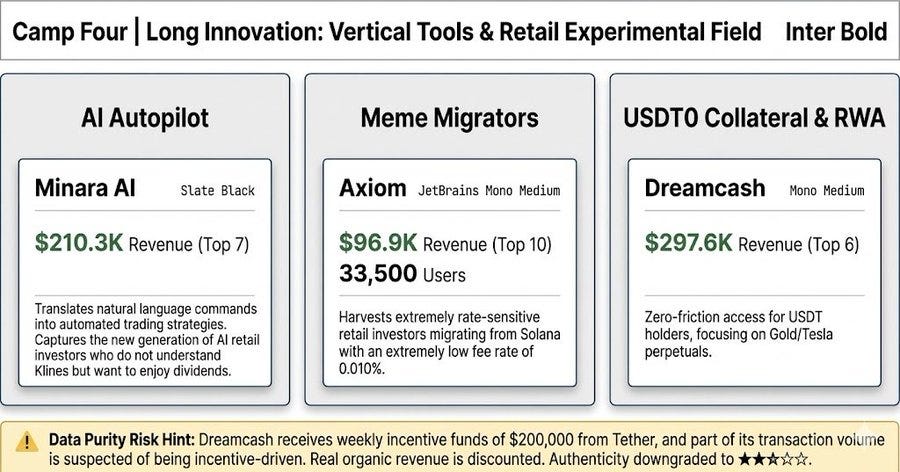
2.4.1 Minara AI
Product Positioning: Minara AI is an AI-driven crypto trading assistant whose core feature is the "AI Trading Autopilot"—executing trading strategies through natural language commands without requiring manual user operation. In 2025, Minara topped the Product Hunt daily chart, becoming one of the most highly-watched AI trading tools. Features:
-
Natural language trading commands ("Buy $1000 worth of BTC perps").
-
AI automatic execution of quantitative strategies.
-
Multi-chain asset management.
-
Built-in Hyperliquid perpetual contract trading.
Revenue Mechanism: Minara collects Hyperliquid trading fees via the Builder Code. A trading volume of $584.07M generated $210.3K in revenue, corresponding to a fee rate of approximately 0.036%.
User Persona: Minara's users are a new generation of AI-native retail users:
-
Interested in AI tools but do not understand traditional trading technical analysis.
-
Hope to achieve "passive income" through AI.
-
Average revenue contribution of $74.98, relatively low, indicating a user base of small-amount retail traders.
-
3,200 unique users, small in scale but with high growth potential.
Core Value Proposition: "Allowing those who don't understand trading to participate in perpetual contracts." The pain point Minara solves is: Perp trading has an extremely high barrier to entry for ordinary users (requiring an understanding of leverage, funding rates, stop-losses, etc.). The AI Autopilot encapsulates these complexities; users simply describe their goals.
2.4.2 Axiom
Product Positioning: Axiom is a trading tool platform in the Solana ecosystem. It originally started as a tool for Meme coin trading on the Solana chain and later expanded to Hyperliquid perpetual contract trading. Core features:
-
Extremely low fees (0.010%).
-
Clean and simple trading interface.
-
Supports dual chains: Solana and Hyperliquid.
-
Geared toward retail users.
Revenue Mechanism: Axiom charges an extremely low Builder Code fee of 0.010%, but thanks to its 33,500 unique users (the second-largest user group) and a trading volume of $969.24M, it still generated $96.9K in revenue.
User Persona: Axiom's users are retail traders from the Solana ecosystem:
-
33,500 unique users, the second most among all Builders.
-
Average revenue contribution is only $63.64, indicating primarily small-amount retail traders.
-
Migrated from Solana Meme coin trading to Hyperliquid perpetual contracts.
-
Extremely sensitive to fee rates (choosing Axiom for its 0.010% rate).
Core Value Proposition: "The lowest-cost channel for Solana retail users to enter Hyperliquid." The pain point Axiom solves is: Solana retail traders want to trade perps but are unwilling to pay high transaction fees. The 0.010% fee rate is the lowest among all major Builders, attracting a massive number of fee-sensitive users.
2.4.3 Dreamcash
Product Positioning: Dreamcash is a perpetual contract trading frontend focused on USDT0 collateral. Its core feature is deploying USDT0-collateralized RWA perpetual contracts (gold, silver, Tesla, Nvidia, and other stocks) on Hyperliquid via the HIP-3 mechanism.
Major Background: In February 2026, Tether made a strategic investment in Dreamcash, providing $200,000 weekly in incentive funds to boost liquidity in the CASH market, with Selini Capital serving as the primary market maker.
Revenue Mechanism: Dreamcash collects trading fees via the Builder Code, while also collecting market fees through HIP-3 market operations. A trading volume of $1.38B generated $297.6K in revenue, corresponding to a fee rate of approximately 0.022%.
User Persona: Dreamcash's users are primarily USDT holders and RWA traders:
-
Hold large amounts of USDT and wish to trade with leverage without swapping coins.
-
Crypto users interested in traditional financial assets (gold, stocks).
-
Average revenue contribution of $171.60, a medium level.
-
7,900 unique users, moderate scale.
Core Value Proposition: "A zero-friction channel for USDT holders to enter Hyperliquid." The pain point Dreamcash solves is: Hyperliquid natively uses USDC as collateral, while a vast number of users hold USDT. Through the USDT0 bridge, Dreamcash allows USDT users to trade directly without needing to swap coins.
3. Lighter's "Dual-Tier Fee" Breakthrough
All of Lighter's revenue comes from Premium Account trading fees, which is an optional paid dual-tier fee system:
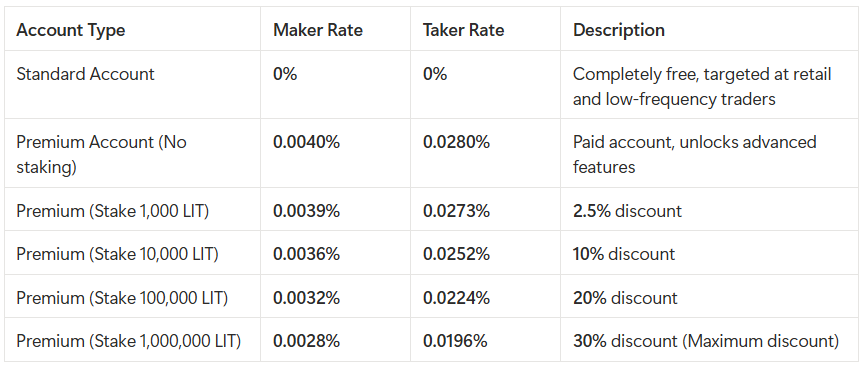
Lighter's fee design is essentially an inverse incentive—the Standard account is completely free, and only users who choose Premium generate revenue. The purpose of this design is to attract a massive number of low-frequency retail traders (for free) while charging high-frequency quantitative users (Premium), forming a dual-tier structure of "free for retail + paid for institutions."
Current revenue data (As of March 9, 2026):
-
24-hour revenue: $102,374
-
Annualized revenue: $37,366,536 (Approx. $37.37M)
-
30-day revenue: Approx. $4.26M
Premium Account Share:
-
Premium share in Maker trades: 57.7% (2,764/4,794 trades)
-
Premium share in Taker trades: 34.5% (2,832/8,214 trades)This means approximately 40-58% of the trading volume comes from paid Premium users, while the rest comes from free Standard users.
According to Lighter's official documentation (docs.lighter.xyz), the Builder Code feature is currently explicitly marked as "coming soon."
This means:
-
Currently, no third-party applications are earning Builder Code revenue through Lighter.
-
No data platforms track the independent revenue of Lighter's ecosystem apps.
-
Lighter's "ecosystem app" revenue is statistically zero.
4. The Key Deciding Factor: Ecosystem Flywheel vs. Ultimate Security
4.1 The Evolutionary Law of On-Chain Trading Platforms Seen from Hyperliquid's Boom
The gap between Lighter and Hyperliquid appears on the surface to be a gap in revenue scale (12.5 times), but fundamentally, it is a gap in the stages of ecosystem construction.
Hyperliquid's ecosystem flywheel is already in motion:
-
High trading volume attracts Builders to integrate.
-
Builders bring in more users.
-
More users generate higher trading volume.
-
Higher revenue attracts even more Builders.
Lighter's ecosystem flywheel has not yet started:
-
Builder Code is not yet online.
-
Unable to track third-party app revenue.
-
Ecosystem apps lack revenue incentives.
-
Ecosystem building lacks positive feedback.
4.2 Moats of Both Parties
Lighter's unreplicable advantages:
-
Ethereum-level Security: The ZK Rollup architecture provides security guarantees that Hyperliquid cannot replicate.
-
Complete Escape Mechanism: User assets can be independently withdrawn via Ethereum under any circumstances.
-
Institutional Compliance Friendliness: Inherits Ethereum's regulatory acceptance, making it more attractive to compliant institutions.
-
Top-tier Investor Endorsement: Invested by top institutions like Founders Fund, Ribbit Capital, and a16z.
Hyperliquid's unreplicable advantages:
-
First-Mover Advantage: The Builder Code ecosystem has been running for 12 months, forming a network effect.
-
Complete On-Chain Ecosystem: The HyperEVM already hosts mature DeFi applications.
-
User Recognition: Brand awareness among retail users is much higher than Lighter's.
-
Revenue Scale: Protocol revenue of $53.11M/month provides formidable financial support.
4.3 Key Conclusions and Insights
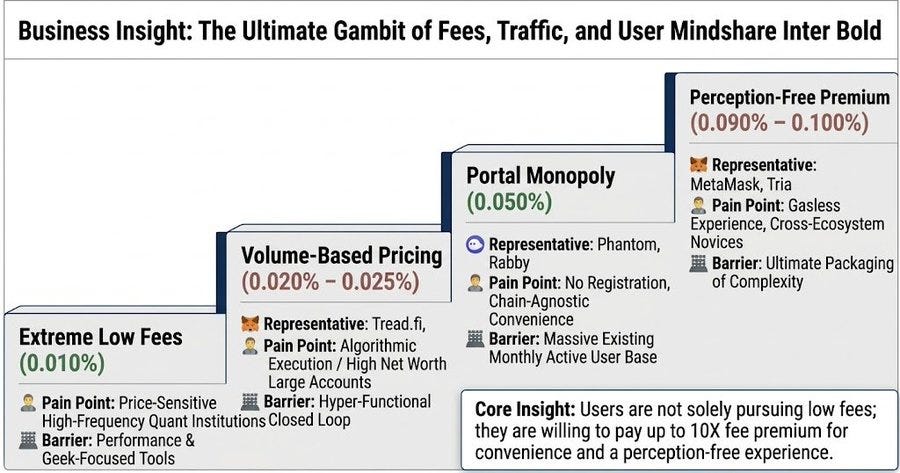
Wallets are the biggest traffic gateways: Phantom ($1.74M) and MetaMask ($688K) account for 43% of the total Builder Code revenue combined, proving the business logic that "wallet equals traffic."
Clear user stratification:
-
Retail users (Phantom, Axiom, Rabby): High user count, low per capita contribution.
-
Super App users (Based, Tria): Medium user count, high per capita contribution.
Fee rates are highly correlated with user types:
-
Retail platforms (Axiom): 0.010% (Lowest)
-
Wallet platforms (Phantom, Rabby): 0.050% (Medium)
-
Super Apps (Based): 0.025% (Low, exchanging price for volume)
-
Institutional platforms (Insilico): 0.010% (Low, but massive trading volume)
Overall high revenue authenticity: Builder Code revenues come from on-chain records and cannot be faked. Out of 10 Builders, 8 have a revenue authenticity rating of "high" or "extremely high," with only Dreamcash containing some inflation due to incentive funds.
Based on current data, the development of Lighter's ecosystem will depend on the following key milestones:
-
Builder Code Launch Time: Once online, integrated apps like Phantom, MetaMask, and Based will immediately generate trackable revenue. Early monthly revenue is projected to reach
-
EVM Ecosystem Maturity: After the Lighter EVM launches, it needs to attract DeFi protocols (DEXs, lending, stablecoins) to deploy and form a complete on-chain financial ecosystem.
-
Organic User Growth: After the points campaign ends, Lighter needs to attract users through the product itself, rather than being incentive-driven. The current $37.37M annualized revenue is an organic revenue base, but sustained growth is still required.
4.3.1 Overall Comparison
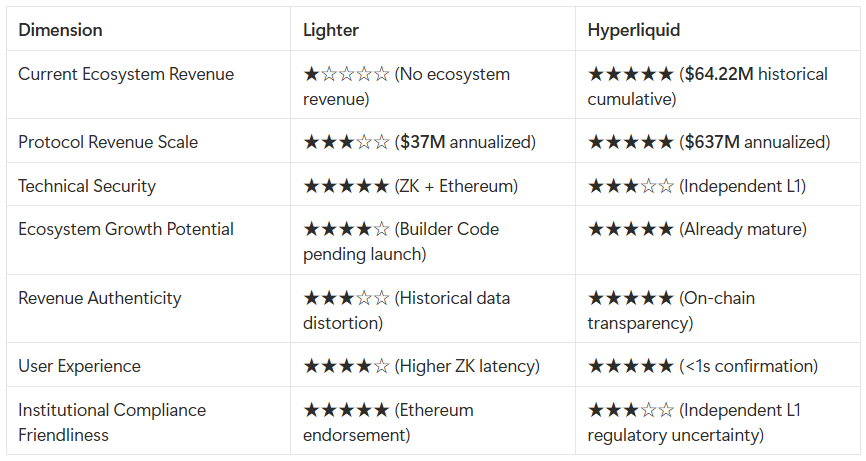
Conclusion
Hyperliquid is comprehensively leading Lighter in overall strength at the current stage, but their positioning is different—Hyperliquid is an on-chain financial operating system, while Lighter is a more secure on-chain exchange. Lighter's value proposition lies in its Ethereum-level security and institutional compliance friendliness, which Hyperliquid cannot replicate. With the launch of its Builder Code and the maturation of its EVM ecosystem, Lighter is expected to form its own ecosystem flywheel in the second half of 2026.
About BlockBooster:
BlockBooster is a next-era alternative asset management firm for the digital age. We leverage blockchain technology to invest in, incubate, and manage the core assets of this new era, from native crypto projects to Real World Assets (RWA). As value co-creators, we are dedicated to unlocking the long-term potential of these assets, capturing exceptional value for our partners and investors in the digital economy.
Disclaimer:
This article/blog is provided for informational purposes only. It represents the views of the author(s) and it does not represent the views of Movemaker or its affiliates. It is not intended to provide (i) investment advice or an investment recommendation; (ii) an offer or solicitation to buy, sell, or hold digital assets, or (iii) financial, accounting, legal, or tax advice. Digital asset holdings, including stablecoins and NFTs, involve a high degree of risk, can fluctuate greatly, and can even become worthless. You should carefully consider whether trading or holding digital assets is suitable for you in light of your financial condition. Please consult your legal/tax/investment professional for questions about your specific circumstances. Information (including market data and statistical information, if any) appearing in this post is for general information purposes only. While all reasonable care has been taken in preparing this data and graphs, no responsibility or liability is accepted for any errors of fact or omission expressed herein.